Showing posts with label world news. Show all posts

Tuesday, 23 October 2012

Candidates spar on foreign policy

Romney accuses Obama of 'apology tour'

US President Barack Obama has forcefully attacked his Republican challenger Mitt Romney, in their third and final presidential debate.
During the tense encounter in Florida, the rivals tangled over the Arab Spring, Iran, Israel and China.
Mr Obama said his rival was "all over the map" on foreign policy. But Mr Romney said the president had allowed "chaos" to engulf the Middle East.
Two instant polls said Mr Obama won the head to head.
'Rising tide of chaos' The Democratic president went on the attack from the start of Monday night's forum, trying to trip up his rival.
But analysts say Mr Obama did not land any knockout blows on Mr Romney, who has been gathering momentum with two weeks to go until election day, in a race that is now neck and neck.
The debate at Lynn University in Boca Raton, which was moderated by veteran CBS News presenter Bob Schieffer, was not as fractious as their second encounter last week, when Mr Obama came out fighting after his lethargic performance in their first meeting.
But there were several scathing exchanges, with the president seeking to portray his challenger as a foreign policy novice who lacked the consistency to be commander-in-chief.
Mr Obama said the former Massachusetts governor had backed a continued troop presence in Iraq, opposed nuclear treaties with Russia and flip-flopped over when the US should leave Afghanistan.
"What we need to do with respect to the Middle East is strong, steady leadership, not wrong and reckless leadership that is all over the map," said Mr Obama.
But Mr Romney charged that the president had allowed a "rising tide of chaos" to sweep the Middle East, giving al-Qaeda the chance to take advantage.
"I congratulate him on taking out Osama Bin Laden and taking on the leadership of al-Qaeda," said Mr Romney, "but we can't kill our way out of this. We must have a comprehensive strategy."


Barack Obama: "Governor Romney hasn't spent enough time looking at how our military works"
Mr Obama hit back sarcastically that he was glad Mr Romney had recognised the threat posed by al-Qaeda, reminding him that he had previously cast Russia as the number one geopolitical foe of the US.
"I know you haven't been in a position to actually execute foreign policy," said Mr Obama, "but every time you've offered an opinion you've been wrong."
Mr Romney, whose tone during the debate was measured, described a trip by President Obama to the Middle East as an "apology tour" that had projected American "weakness" to enemies, while bypassing close ally Israel. Mr Obama called that claim the "biggest whopper" of the campaign.
Mr Romney also said: "We're four years closer to a nuclear Iran", although he appeared to soften the uncompromising tone that has been the hallmark of his campaign by emphasising that military action should be a last resort.

Sunday, 18 December 2011

Top Travel News of 2011


For travelers, 2011 was the year of the shake-up. Old certainties were challenged; former ways of doing things, rethought. Travelers saw Southwest merge with AirTran. Deal-a-day site Groupon gave online travel agencies their first serious competition in ages. The year's other online travel sensation, Airbnb—a site that offers lodging in people's homes—dealt with news that one renter had trashed and robbed a site member's home, renewing questions about the kindness of strangers.

Looking abroad, the revolts in North Africa and the Middle East shifted travel patterns—most dramatically in Cairo, where famous museum halls echoed emptily for months. Cruise lines suspended stops at a couple of Mexican ports, prompting local officials to introduce measures to better protect passengers. Meanwhile, some international travelers took advantage of opportunities to fly the new, high-tech Dreamliner 787 from Boeing.

Back at home, the government tested new ideas in airport security and permitted Americans to visit Cuba as part of licensed educational tour groups. Finally, officials opened Manhattan's oft-debated memorial to the victims of the September 11 terrorist attacks.

Here, a chance to cap off 2011 and learn (or remember, in some cases) the biggest stories of the year that affect how we travel and see the world now—and in years to come.

Flying Started to Get More Comfortable

Anyone who swears that it's just about the journey, and not the destination, has never logged hours crammed into an economy-class seat on an airplane that feels as dry as the Sahara. But a new era in comfier cabins dawned in 2011, thanks to the debut of a high-tech aircraft design. In October, Boeing's latest jumbo jet, the 787 Dreamliner, took its inaugural flight. The 787's cabins maintain higher humidity levels than traditional ones, sparing passengers from dry eyes and mouths. The 787s also pressurize their cabins to a more earth-like level than older planes, avoiding the altitude sickness some fliers feel in the air. They're quieter machines, too, and sound like you're riding in a hybrid car instead of a gas-powered one. The first airlines to use the aircraft are in Asia; United will bring the plane into U.S. service next year. Boeing's aerospace rival Airbus plans to launch similarly designed planes, dubbed the A350 series, within a year or two. It looks like high-tech cabins will soon be commonplace. Sure, no matter what a plane is made of, flights remain nasty, brutish, and not short enough. But we applaud every aircraft improvement travelers can get.

Cruise Lines Become Wary of Mexico

Mention Mexico, and some Americans think of violence linked to a government crackdown on drug trafficking and turf battles between various narcos. Case in point: In Mazatlán, two visitors were shot in the parking lot of a hotel frequented by foreign tourists, prompting cruise lines to suspend port calls. In the first half of 2011, the number of cruise-ship passengers to Mexico dropped from about 500,000 to 58,000. Puerto Vallarta faced similar security concerns after incidents there. Yet nearly all of the violence has taken place far from cruise ports. Cancún, for instance, has remained safe, except for an attack in August on a bar in an outlying residential area. At Mazatlán, officials have put into place additional security measures, too, such as beefed-up police patrols and strict supervision of tour buses as passengers board them for day excursions. So expect more cruise lines to return to full itineraries soon. Princess Cruises Lines, for one, will begin calling on Mazatlán and Puerto Vallarta again in 2012.

The Arab Spring Causes Unrest in Popular Tourist Destinations

Nothing prepared us for what happened across the Arab world this year, with uprisings toppling repressive regimes in Tunisia, Yemen, and Libya and protests continuing in Bahrain. But it was the revolution in Egypt that set off the biggest political shockwaves — and prompted the largest travel industry shake-up, too. Egypt is thought to have drawn only 10 million international visitors in 2011, down from 14.8 million a year earlier. Experts note that not a single tourist has suffered a scratch because of the turmoil to date. But the ongoing political uncertainty concerns many, and understandably so. Here's hoping that the country's commitment to keeping travelers safe remains solid during Egypt's continuing march to democracy.

Paris Jackson to talk about film debut


LOS ANGELES: Michael Jackson's 13-year-old daughter Paris is working on her movie debut -- and she will talk about it in public for the first time this week.

Paris, who was 11 when her father died in 2009, will star in a live action/animated called "Lundon's Bridge and the Three Keys," based on a famous book series for teenagers.

The film's website says she plays heroine Lundon O'Malley in a story where magic "turns a dolphin into a human, a teenage boy into a dragonfly and a loving jellyfish queen into an evil fairy godmother."

The website, linked from her Twitter page, adds that she will be on the Ellen DeGeneres television show on Wednesday, talking about the movie for the first time.

Her movie debut news comes after a tough few months for the Jackson family, as the star's doctor Conrad Murray stood trial for involuntary manslaughter over his death on June 25, 2009.

Israel frees 550 Palestinian prisoners


RAMALLAH: Israel on Sunday freed 550 Palestinian prisoners, completing the second phase of the deal which saw Israeli soldier Gilad Shalit freed in October, Palestinians said.

Officials in the West Bank city of Ramallah said that the main contingent of freed prisoners entered the city, where thousands of well-wishers awaited them at the presidential headquarters. (AFP)

Monday, 31 October 2011

Chasing America's deadliest storms

Each year Sam Hall, who has a rare genetic condition, drives with her brother Keith across the US to experience tornadoes first-hand.

Tornado researcher Sam Hall found herself heading into America's deadliest tornado that destroyed the town of Joplin, Missouri, on her latest storm-chasing trip.
From Warrington, Cheshire, she is the editor of the International Journal of Meteorology but also has to battle a rare genetic condition, Epidermolysis Bullosa (EB), in which her skin and internal body linings blister at the slightest knock.
Each year Sam drives herself and her brother Keith thousands of miles across America to experience tornadoes first-hand.

Suicide bombers hit US charity in Kandahar

KANDAHAR: Suicide attackers on Monday blew up a truck bomb and raided the offices of a US charity in Kandahar, killing at least four Afghans in the main city of southern Afghanistan, officials said.

One attacker detonated the vehicle outside the offices of US-based International Relief and Development (IRD), before two others entered the compound and fired on security forces, said police and government officials.

The Kandahar government said the attackers struck at 6am (0130 GMT) and that two gunmen remained holed up in a veterinary clinic inside the compound - which also houses UN offices - and were shooting at security forces.

"There were three suicide attackers. One exploded in front of the office. The two others entered the compound (wearing suicide vests). They are still alive, but the police are surrounding them," said police spokesman Ghorzang.

Taliban spokesman Yousuf Ahmadi said the insurgent group carried out a car bomb attack in the city, but claimed to have targeted the UN refugee agency.

The bodies of the dead were taken to the nearby Mirwais hospital along with several people wounded in the assault.

"Four bodies, all Afghan civilians, and five people including a Nepali guard have been admitted to our hospital with injuries," said Sardar, a hospital doctor who like many Afghans goes by only one name.

The United Nations has some offices in the compound but the Kandahar government's media office said the UN properties appeared safe. 

Friday, 28 October 2011

Russia's top ski jumper Karelin dies in car accident

Pavel Karelin, Russia's leading ski jumper, died in a car crash. He was 21. 


"Pavel Karelin's tragic death is a huge and irreplaceable loss for Russian sport," the country's ski jumping federation said in a statement.
"He was the leader of our team; one of our big hopes (for the 2014 Sochi Olympics)," added Russian Olympic Committee department head Alexander Grushin.
Police said Karelin died in the early hours when his Mercedes collided with another vehicle on a motorway near Nizhny Novgorod, some 570 kilometres east of Moscow.
Karelin had competed regularly on the World Cup circuit. His best result was second place in Garmisch-Partenkirchen in January.
He took part in the 2010 Vancouver Olympics, finishing 10th in the team competition and 33rd in the individual event.

Tuesday, 25 October 2011

Turkey earthquake: Death toll rises to 432


The death toll from an earthquake in eastern Turkey has risen to 432 people, officials said, as rescue teams raced to find survivors beneath the rubble.
At least 1,300 others were injured in Sunday's disaster, officials said.
Three generations of the same family - a two-week-old baby girl, her mother and grandmother - have been found alive by rescue workers.
Meanwhile, thousands of homeless people in the cities of Van and Ercis slept in tents or outside for a second night.
Baby Azra Karaduman survived for almost 48 hours before she was found by rescue workers.
Hours later, her mother, Semiha, was pulled from the flattened building, where she had been pinned next to a sofa, the AP news agency reports.
"I am so excited. What can I say? Let God help them," the child's other grandmother, Sevim Yigit, told Reuters news agency.
The baby's father is still missing, although he was thought to be alive hours earlier.
Earlier, as a pregnant woman and her two children were also pulled out of the rubble, reviving hopes for those still searching for loved ones.
Turkish officials have promised more aid to those in need, saying 12,000 more tents would be delivered to the region.
Survivors and opposition politicians have criticised the government for failing to provide enough supplies.
Rescue teams with sniffer dogs continued to search for survivors under the rubble through the night and into Tuesday.
Cranes have been lifting slabs of concrete, and many residents have been joining in the rescue effort, digging with shovels.
In Ercis, one of the worst-hit cities, Derya Coskun, her daughter Elif and son Ozer were removed from the debris after being found by emergency workers.
A two-week-old baby girl is rescued from the rubble of a collapsed building.


Meanwhile, TV footage showed a couple, a police officer and his wife being pulled out of a public building, AFP reports.
But hopes are fading for many more who remain unaccounted for, and Turkish officials warn that the death toll is likely to rise.
In one building there are fears that up to 50 could be buried under the rubble.
'Shivering'
Turkish Deputy Prime Minister Besir Atalay, in charge of the relief operation, said late on Monday that "from today there will be nothing our people lack".
His announcement came after some survivors complained that not enough help was reaching them.
"We shivered all night long, nobody provided us with any blankets or heaters, we don't even have a toilet," one woman, who is staying in a tent, told the BBC.
In Ercis, a lorry loaded with supplies was mobbed by young men who climbed the sides to claim tents and blankets, leaving the older and less able shouting in anger.
Opposition politicians earlier decried what they called "a lack of crisis management" and said Ankara was wrong to refuse offers of foreign aid.
Turkey is particularly vulnerable to earthquakes because it sits on major geological fault lines.

Saturday, 22 October 2011

Thailand floods: Crisis 'to last four to six weeks'

Thailand's worst flooding in decades is set to last another four to six weeks, the country's prime minister has said.
Yingluck Shinawatra warned people in Bangkok to be prepared for flooding there, describing the situation as "extremely serious".
Three months of heavy monsoon rain have left swathes of the country flooded and led to the deaths of some 350 people.
Northern and central areas were worst hit initially but now the run-off is draining south, threatening Bangkok.
Prime Minister Yingluck has used a disaster law to take control of the emergency response, and in her weekly TV address to the nation told Bangkok residents to move their belongings at least one metre (3ft 3in) off the ground.
"Bangkok must open all floodgates to allow the water through," the PM said. "So during this long weekend residents should move belongings, cars and other valuable things to places at least one metre high."
"There is a huge volume of run-off water from the north and we can't effectively block it but can only slow the flow because our barriers are temporary."
The BBC's Rachel Harvey, in Bangkok, says water is continuing to breach barriers in the city's northern suburbs, and although central Bangkok is still dry, the situation around the capital is not getting any better.
The authorities want to drain the water to the east and west of the city, avoiding the possibility of a major torrent running through the heart of the capital.
However, our correspondent says the move is a change of tactic for the government - and no-one seems entirely sure whether the volume of water can be safely controlled.
Ms Yingluck also said the crisis had displaced more than 110,000 people from their homes. The government said the death toll had risen to 356.
Thailand's tourism industry has so far been largely unaffected, with southern islands escaping the flooding. The main international airport is operating as normal and its flood defences have been fortified.

Thursday, 13 October 2011

Unix creator Dennis Ritchie dies aged 70

Pioneering computer scientist Dennis Ritchie has died after a long illness.
Mr Ritchie was one of the creators of the hugely influential Unix operating system and the equally pioneering C programming language.
A vast number of modern technologies depend on the work he and fellow programmers did on Unix and C in the early days of the computer revolution.
Those paying respects said he was a "titan" of the industry whose influence was largely unknown.
The first news of Mr Ritchie's death came via Rob Pike, a former colleague who worked with him at Bell Labs. Mr Ritchie's passing was then confirmed in a statement from Alcatel Lucent which now owns Bell Labs.
Jeong Kim, president of Alcatel-Lucent Bell Labs, said Mr Ritchie would be "greatly missed".


"He was truly an inspiration to all of us, not just for his many accomplishments, but because of who he was as a friend, an inventor, and a humble and gracious man," said Mr Kim.
Along with Ken Thompson, Brian Kernighan, Douglas McIlroy, and Joe Ossanna, Mr Ritchie was one of the key creators of the Unix operating system at Bell Labs during the 1960s and 70s.
Unix's influence has been felt in many ways. It established many software engineering principles that persist until today; it was the OS of choice for the internet; it kicked off the open source movement and has been translated to run on many different types of hardware.
It was also at Bell that Mr Ritchie created C, one of the most widely used programming languages in the world. It is familiar to almost every modern-day developer.
In 1999, Mr Ritchie's influence and accomplishments won official notice when he was awarded the US National Medal of Technology - the highest honour America can bestow on a technologist.
Mr Pike said that with his passing, the world had lost a "truly great mind."
Paying tribute on his blog, Google programmer Tim Bray said it was impossible to overstate the debt his profession owed to Dennis Ritchie.
"I've been living in a world he helped invent for over thirty years," he wrote.

Tuesday, 11 October 2011

SPOTTED! Eight months pregnant Ash!


Actor Aishwarya Rai Bachchan, 37, who is eight months pregnant, attended the launch of the Sri Hanuman Chalisa album in Mumbai on Sunday.
Her father-in-law, actor Amitabh Bachchan, has also sung in the album.
Ash, who wore an off-white, Abu Jani-Sandeep Khosla suit, was seen holding a dupatta over her baby bump as she walked in with mother-in-law Jaya Bachchan.
AshAishwarya was also spotted during the Navaratri celebrations.

Monday, 10 October 2011

Scientists to develop deep ocean seismic network

SAN DIEGO: The Scripps Institution of Oceanography has been awarded a $1 million grant to develop a deep sea seismic network. Scientists hope this new system will plug current monitoring gaps.

Ships typically deploy earthquake sensors in the ocean that gather data for a certain amount of time before they are retrieved by vessels.

Scripps will pair with industry in the project that's being funded by the National Science Foundation. Data from the sea floor sensors will be transmitted to a surfboard-sized autonomous unmanned vessel on the ocean's surface, and then to shore via satellite.

Researchers say the unmanned vessel would be able to stay stationary for longer periods of time, allowing for more data collection.

Sunday, 9 October 2011

Man with world's largest feet finds fame


PARIS: The first thing that people notice about Brahim Takioullah is not his feet - which he hopes will make him famous - but his enormous height. He stands more than eight foot (246 cm) tall.

As he strolls through downtown Paris people gasp, stare, take his picture and ask: "Are you the tallest man in the world?" He's not, not quite, but he does have the biggest pair of feet on the planet -- and that's official.

Judges from Guinness World Records came to France to measure him and confirmed his suspicion that he had record-breaking feet -- his left measuring one foot three inches (38.1 cm) in length and his right, one foot 2.76 inches.

Takioullah cannot stand up straight in the small flat he shares with his mother in the Paris suburbs, has difficulty getting into a taxi or the Metro, and can never move around without attracting attention.

But he is surprisingly good humoured about his situation, smiling and posing for cellphone snaps and politely answering questions about his condition, a rare medical problem that he hopes to cure through surgery.

Takioullah is from Morocco, and grew up in a small village -- grew up fast. In one year in his teens he put on more than three feet (one metre) in a spurt.

Now 29, no-one thought to investigate his unusual size until he was 18.

Acromegaly is a pituitary gland disorder that causes the body to produce excessive growth hormone. The brain tumour can lead to other problems aside from great size, and Takioullah was advised to seek surgery.

But first he decided to finish his university studies in geography. When he began treatment, he was already huge and closing in on the world's tallest man, eight-foot three-inch (2.51 metre) Sultan Kosen of Turkey.

Five years ago, a French doctor brought him to Paris for treatment, and he is not expected to reach Sultan's height record.

Takioullah contacted Guinness himself to challenge for the record, and says he is proud to have it recognised, though daily life is not without its problems.

He hopes one day to have a specially built car he could drive himself, but for now even getting a pair of shoes stretches his budget -- he takes a European size 58, which no shop has ever stocked.

This week he met an orthopedic podiatrist to be fitted with a specially made pair designed to support his huge weight.

French doctors are working to reduce Takioullah's brain tumour, and he hopes his newfound fame will help him find the specialist treatment he needs.

"The record now will be known around the world, and experts anywhere around the planet may be able to help," said Craig Glenday of Guinness World Records, publisher of the famous guide to the world's extremes.

Thursday, 6 October 2011

Indian Ocean tsunami-alert test on 12th

PARIS: Nearly two-dozen countries next Wednesday will take part in a full-scale test of the Indian Ocean's tsunami alert system, using the 2004 Sumatra quake as the basis for the exercise, UNESCO said on Thursday.

Exercise IOWAVE 11 will re-enact the seismic events of December 26, 2004, simulating a 9.2-magnitude quake that occurs northwest of Sumatra, sending waves across the Indian Ocean that strike the coast of South Africa 12 hours later.

It will be a trial run for newly launched Regional Tsunami Service Providers (RTSPs), located in Australia, India and Indonesia, which will issue simulated "alerts."

They are part of a region-wide tsunami warning and mitigation service, set up by 28 countries after the 2004 disaster, which claimed nearly a quarter of a million lives.

Until now, two bodies -- the Japan Meteorological Agency and the Pacific Tsunami Warning Centre -- have been in charge of tsunami alerts in the Indian Ocean.

They will end this interim job at the end of 2012, provided the handover goes well.

"The exercise aims to evaluate the system's operational capacity, the efficiency of communications among the different actors and the state of preparation of national emergency services," the UN's Educational, Scientific and Cultural Organisation (UNESCO) said in a press release here.

"The test will also include the evacuation of coastal communities in several countries, notably India and Malaysia."

So far, 23 countries have signed up for the October 12 test.

They are: Australia, Bangladesh, Comoros, East Timor, France (La Reunion), India, Indonesia, Iran, Kenya, Madagascar, Malaysia, Maldives, Mauritius, Mozambique, Myanmar, Oman, Pakistan, Seychelles, Singapore, Sri Lanka, Tanzania, Thailand, and Yemen

The Indian Ocean system was devised by the Intergovernmental Oceanographic Commission (IOC), a UNESCO body.

Tuesday, 4 October 2011

Amir Khan to defend title in Washington

LONDON: Britain's Amir Khan will defend his world light-welterweight titles against US mandatory challenger Lamont Peterson on December 10 in Washington, it was confirmed Tuesday.

Khan, 26-1 with 18 knockouts, has won eight fights in a row, most recently last July in Las Vegas when he knocked out Zab Judah in the fifth round to unify the World Boxing Association and International Boxing Federation titles.

"I am looking forward to returning to the United States to face a worthy challenger like Lamont Peterson," Khan said in a statement.

"I always said I wanted to be active and a true world champion and I will prove it on December 10.

"I know Lamont is a strong contender but it doesn't matter that I'm fighting him in his back yard, I'm coming in as champion and will leave as champion."

Peterson, 29-1-1 with 15 knockouts, fought Victor Ortiz to a 10-round draw last December on the undercard of Khan's unanimous decision victory over Marcos Maidana.

The fight is expected to be the last for the Englishman in the division before he moves up next year to welterweight, where possible opponents could include unbeaten US star Floyd Mayweather and Filipino icon Manny Pacquiao.

Peterson's only loss came in his only prior world title fight, when he dropped a unanimous 12-round decision in December of 2009 to Tim Bradley.

India, Afghanistan ink strategic partnership deal


NEW DELHI: India and Afghanistan on Tuesday signed a strategic partnership agreement deepening their economic and security ties, Indian Prime Minister Manmohan Singh said.

Singh reached the deal with Afghan president Hamid Karzai during talks in New Delhi in a move likely to raise suspicion in Pakistan, which is already wary of the relationship between its two neighbours.

The deal is the first such pact signed by Afghanistan as it eyes alliances to help guarantee its security as international troops begin withdrawing from the war-torn country after more than a decade of fighting.

"My discussions with President Karzai have once again underscored the importance of a strong and broad-based partnership between India and Afghanistan," Singh said.

Singh explained that the strategic partnership agreement would cover security cooperation, trade and economic ties, as well as social and cultural exchanges.

The two leaders also signed two separate deals increasing links in mining and energy.

The agreements come at a time of severely strained ties between Pakistan and Afghanistan.

Karzai has accused Pakistan of supporting militant networks in his country and of having links to the recent assassination of peace envoy and former president Burhanuddin Rabbani.

"Afghanistan recognises the dangers that this region faces through terrorism and radicalism that is being used as an instrument of policy against our citizens," he said in a veiled reference to Pakistan

Monday, 3 October 2011

Spurs down Arsenal, Lampard destroys Bolton


Chelsea's English midfielder Frank Lampard (L) celebrates after his third goal during the English Premier League football match between Bolton and Chelsea at the Reebok stadium, Bolton, north-west England on October 2 2011.-AFP Photo

LONDON: Tottenham piled on the misery for north London rivals Arsenal as Kyle Walker’s long-range strike clinched a 2-1 win, while Frank Lampard hit a hat-trick in Chelsea’s 5-1 victory at Bolton on Sunday.
Harry Redknapp’s side condemned the Gunners to their fourth defeat in seven Premier League games this season after Arsenal goalkeeper Wojciech Szczesny failed to deal with Walker’s swerving 30-yard effort in the 73rd minute at White Hart Lane.
Sixth-placed Spurs had taken the lead through Rafael van der Vaart’s cool finish in the 40th minute, although the Dutch midfielder appeared to use the upper part of his arm to control Emmanuel Adebayor’s pass prior to the goal.
Arsenal equalised in the 51st minute when Wales midfielder Aaron Ramsey finished off Alex Song’s cross from close-range, but Walker settled a fiercely-fought derby when his shot slipped through Szczesny’s grasp.
There was more bad news for Arsenal boss Arsene Wenger, whose side are languishing just two points off the relegation zone in 15th place, as France right-back Bacary Sagna was stretchered off in the second half.
“I went for a very attacking team,” Redknapp said. “To be honest I nearly made a change before half-time to thicken us up in midfield but we upped it and got stronger and we had all the chances in the second half.”
At the Reebok Stadium, Lampard showed he still has plenty to offer with the sixth treble of his career as Andre Villas-Boas’s side routed bottom of the table Bolton, who have now lost six successive matches, to move back into third place, three points behind leaders Manchester United.
“It was good for him,” Villas-Boas said. “He arrived with perfect timing into the box as he has done in the past years. His talent was never in question.
“It is not a question of age – it is a question of competence, and this squad is full of competence.”
The Blues took the lead after just 92 seconds when Daniel Sturridge, who enjoyed a successful loan spell at Bolton last season, punished poor marking to head Juan Mata’s corner past Adam Bogdan.
Sturridge turned provider in the 15th minute as his perfectly weighted pass was swept into the net by Lampard.
Chelsea’s third goal arrived in the 25th minute. Sturridge’s low shot from the edge of the area should have been dealt with, but Bogdan somehow managed to push it into his own net.
Bogdan was at fault again when Lampard scored his second two minutes later with a tap in after the Hungarian goalkeeper spilled David Luiz’s shot.
Dedryck Boyata got one back for Bolton with a header from Martin Petrov’s 46th minute free-kick, but Lampard completed his treble when he exchanged passes with Didier Drogba and slotted home in the 59th minute.
Elsewhere, Fulham romped to their first league win this season as Andrew Johnson’s hat-trick inspired a 6-0 demolition of west London rivals QPR at Craven Cottage.
Martin Jol’s side had gone six matches without a victory, but Johnson struck from close-range in the second minute and Danny Murphy netted a 20th minute penalty after a Paddy Kenny foul on Johnson.
The game was all but over when Johnson scored again in the 38th minute and he earned his treble with a fierce effort in the 59th minute.
Clint Dempsey got the fifth six minutes later and Bobby Zamora sealed the rout in the closing stages.
“We had injuries and we were at sixes and sevens at the back and it showed. They cut through us like a knife through butter,” QPR boss Neil Warnock said.
Swansea striker Danny Graham scored his first goal for the club as Brendan Rodgers’ side beat Stoke 2-0 at the Liberty Stadium.
Scott Sinclair opened the scoring with a ninth minute penalty after the former Chelsea winger was brought down by Ryan Shawcross.
Then Graham, who cost a club record 3.5 million pounds from Watford in pre-season, put the result beyond doubt when he lifted his shot over Stoke goalkeeper Asmir Begovic in the 85th minute.

Afghan women’s rights ‘at risk’ after war decade


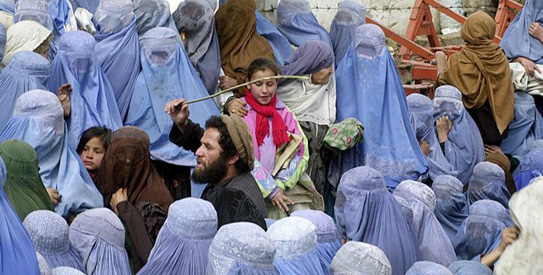
A man from an aid-distribution team uses a stick to control a crowd of Afghan women who gather to get relief in Kabul 01 March 2002. – AFP Photo
KABULL Women’s rights in Afghanistan risk being forgotten as international troops withdraw and the government struggles for a peace deal 10 years after the Taliban were ousted, Oxfam said Monday.
In a new report the NGO said women’s rights had improved in Afghanistan since the October 2001 US-led invasion, particularly access to education, with 2.7 million girls now in school compared to a tiny number under the Taliban.
But it also warned of an “uncertain future” and a “downward slide,” citing increasing violence against women and fears that any future peace deal with the Taliban could “sacrifice” the gains.
“Women in Afghanistan have achieved real progress in areas such as political participation, the rule of law, and education since 2001 but these hard-won gains remain fragile,” Oxfam’s report said.
“With the imminent withdrawal of international forces, there is a risk that the government may sacrifice women’s rights in order to secure a political deal with the Taliban and other armed opposition groups.” All 140,000 foreign combat troops are due to leave Afghanistan by the end of 2014, handing control of security to Afghan forces.
President Hamid Karzai is currently reviewing his strategy of trying to talk peace with the Taliban after the assassination of his peace envoy Burhanuddin Rabbani, which experts say has dealt a heavy blow to hopes of reconciliation.
The US and other countries made restoring women’s rights a key priority in Afghanistan after the October 7, 2001 invasion which ousted the Taliban in the wake of the 9/11 attacks in the US.
Under the militant Islamist regime, women were banned from working outside the home, forced to wear burqas and had to be escorted by a male relative whenever they left their houses.
Major gains have been made in the last decade, Oxfam said.
Some 42 percent of primary school age girls are enrolled in school and Afghanistan has one of the world’s highest rates of parliamentary female representation at 28 percent, albeit thanks to a quota system.
However, Oxfam warned such improvements were under threat as “women are increasingly caught between a spreading insurgency, a government that is willing to sacrifice women’s rights and an international community focused on rapidly reducing its military presence in Afghanistan”.
It also pointed to a sharp divide between experiences and attitudes in urban and rural areas in what is one of the world’s poorest countries.
The report highlighted disturbing levels of violence against women and said that a key law criminalising practices such as honour killings and child marriage was only being implemented in 10 out of 34 Afghan provinces.
Some 87 percent of Afghan women say they have suffered “physical, sexual or psychological violence or forced marriage,” Oxfam said, while self-immolation still happens.
The Taliban also continue to attack girls’ schools and limit the movements of women in areas which they control, the report added.
It accused Karzai’s fragile government of a “willingness to sacrifice women’s rights for political ends” in order to gain the support of hardliners and bolster its own position.
Oxfam urged officials to ensure that any future peace deal with the Taliban involves women and guarantees women’s rights.
“Women are working as doctors, lawyers and businesswomen and girls are at school,” said report co-author Orzala Ashraf Nemat.
“But what is life going to be like for us in the next 10 years? Already life is getting tougher for Afghan women. Afghan women want peace — not a stitch-up deal that will confine us to our homes again.”

Sunday, 2 October 2011

Tory conference: Cameron in jobs and homes vow

David Cameron has promised up to 200,000 extra affordable homes and 400,000 new jobs in an interview with the BBC's Andrew Marr Show.
The PM ruled out a U-turn on spending cuts but denied he was "sitting back" in the face of economic stagnation.
He cited plans to boost the "right-to-buy" in England and release government land as examples of action being taken.
But Labour said the economy was "flatlining" thanks to his policies and he had run out of ideas.
Mr Cameron dismissed calls for "a few billions" of extra spending - suggesting it would be a dangerous gamble to "deviate" from the government's tight deficit-reduction plans, as the Conservatives gathered in Manchester for their annual conference.


David Cameron claims to be "firing up the engines of growth" with plans to extend the right-to-buy, as the Tory conference gets under way in Manchester.
His comments came as police said an estimated 30,000 people were marching through the centre of the city in protest at the coalition's spending cuts.
Asked about claims by a senior Tory backbencher that the government lacked a coherent strategy for growth, Mr Cameron said: "We are firing up the engines of the British economy.
"There is a step change taking place right now. This government is not just sitting back."
The government is to increase the discounts available to council housing tenants in England who want to buy their own homes.
The move is an extension of a the "right-to-buy" policy which proved a vote winner for Margaret Thatcher - but which critics said decimated the stock of social housing and fuelled a house price bubble.
Cash raised by the sale of council housing will be spent on buying further homes, which will then be rented out at a reduced rate, under the plans to be outlined fully in a housing strategy later this year.
Asked by the BBC's Andrew Marr if there were enough council tenants for it to make a difference, he said: "There are over two million homes that are still available to be bought.
"So this is something that will make a big difference. And again that could provide another 100,000 homes, another 200,000 jobs.
"So taking those two policies together that could be 200,000 extra homes, 400,000 extra jobs."


Libya conflict: Hundreds of residents flee Sirte

Streams of civilians are fleeing the besieged Libyan city of Sirte, ousted leader Muammar Gaddafi's birthplace.
Hundreds of residents, in vehicles packed with belongings, are queuing at checkpoints leading out of the city.
Transitional authority forces say they are observing a truce to encourage the remaining civilians to get out, before launching a final assault.
Meanwhile, an International Red Cross team has been into Sirte and says there is an urgent need for medical aid.
Sirte is one of two major cities still holding out against the National Transitional Council (NTC) forces.