Showing posts with label interesting news. Show all posts

Monday, 29 October 2012

Watching a horror film 'burns nearly 200 calories'

A new study has revealed that watching scary movies can burn up to 200 calories a sitting.
The adrenaline rushes that viewers experience during a 90-minute horror film are believed to use up the same amount of energy as is contained within a bar of chocolate.


According to The Sunday Telegraph, scientists from the University of Westminster monitored the total energy expenditure of ten different people as they watched a selection of movies. Participants' heart rates, oxygen intake and carbon dioxide output were measured and the study found that on average, the number of calories used increased by a third during horror film viewing. The movie that burned the most calories across the board was 1980 psychological thriller The Shining, with the average viewer using up 184 calories - close to the amount burned during a half-hour walk.


Classic shark horror Jaws finished second, with viewers burning on average 161 calories, and The Exorcist came third, with participants using up around 158 calories during each viewing. The research also confirmed that films featuring shock moments designed to make viewers jump are the best calorie-burners, as they cause a spike in heart rate. "Each of the ten films tested set pulses racing, sparking an increase in the heart rate of the case studies," explained Dr Richard Mackenzie, senior lecturer and specialist in cell metabolism and physiology at the University of Westminster. "As the pulse quickens and blood pumps around the body faster, the body experiences a surge in adrenaline. "It is this release of fast acting adrenaline, produced during short bursts of intense stress (or in this case, brought on by fear), which is known to lower the appetite, increase the Basal Metabolic Rate and ultimately burn a higher level of calories." Helen Cowley, editor of LOVEFiLM - which commissioned the study - added: "We all know the feeling of wanting to hide behind the sofa or grab a pillow when watching scary or hair raising scenes, but this research suggests that maybe those seeking to burn some calories should keep their eyes on the screen."

The top ten calorie-burning horror films are as follows: 

1.1. The Shining: 184 calories
2.2. Jaws: 161 calories
3.3. The Exorcist: 158 calories
4.4. Alien: 152 calories
5.5. Saw: 133 calories
6.6. A Nightmare on Elm Street: 118 calories
7.7. Paranormal Activity: 111 calories
8.8. The Blair Witch Project: 107 calories
9.9. The Texas Chain Saw Massacre: 105 calories
10.10. [Rec]: 101 calories

Tuesday, 23 October 2012

Candidates spar on foreign policy

Romney accuses Obama of 'apology tour'

US President Barack Obama has forcefully attacked his Republican challenger Mitt Romney, in their third and final presidential debate.
During the tense encounter in Florida, the rivals tangled over the Arab Spring, Iran, Israel and China.
Mr Obama said his rival was "all over the map" on foreign policy. But Mr Romney said the president had allowed "chaos" to engulf the Middle East.
Two instant polls said Mr Obama won the head to head.
'Rising tide of chaos' The Democratic president went on the attack from the start of Monday night's forum, trying to trip up his rival.
But analysts say Mr Obama did not land any knockout blows on Mr Romney, who has been gathering momentum with two weeks to go until election day, in a race that is now neck and neck.
The debate at Lynn University in Boca Raton, which was moderated by veteran CBS News presenter Bob Schieffer, was not as fractious as their second encounter last week, when Mr Obama came out fighting after his lethargic performance in their first meeting.
But there were several scathing exchanges, with the president seeking to portray his challenger as a foreign policy novice who lacked the consistency to be commander-in-chief.
Mr Obama said the former Massachusetts governor had backed a continued troop presence in Iraq, opposed nuclear treaties with Russia and flip-flopped over when the US should leave Afghanistan.
"What we need to do with respect to the Middle East is strong, steady leadership, not wrong and reckless leadership that is all over the map," said Mr Obama.
But Mr Romney charged that the president had allowed a "rising tide of chaos" to sweep the Middle East, giving al-Qaeda the chance to take advantage.
"I congratulate him on taking out Osama Bin Laden and taking on the leadership of al-Qaeda," said Mr Romney, "but we can't kill our way out of this. We must have a comprehensive strategy."


Barack Obama: "Governor Romney hasn't spent enough time looking at how our military works"
Mr Obama hit back sarcastically that he was glad Mr Romney had recognised the threat posed by al-Qaeda, reminding him that he had previously cast Russia as the number one geopolitical foe of the US.
"I know you haven't been in a position to actually execute foreign policy," said Mr Obama, "but every time you've offered an opinion you've been wrong."
Mr Romney, whose tone during the debate was measured, described a trip by President Obama to the Middle East as an "apology tour" that had projected American "weakness" to enemies, while bypassing close ally Israel. Mr Obama called that claim the "biggest whopper" of the campaign.
Mr Romney also said: "We're four years closer to a nuclear Iran", although he appeared to soften the uncompromising tone that has been the hallmark of his campaign by emphasising that military action should be a last resort.

Sunday, 18 December 2011

Top Travel News of 2011


For travelers, 2011 was the year of the shake-up. Old certainties were challenged; former ways of doing things, rethought. Travelers saw Southwest merge with AirTran. Deal-a-day site Groupon gave online travel agencies their first serious competition in ages. The year's other online travel sensation, Airbnb—a site that offers lodging in people's homes—dealt with news that one renter had trashed and robbed a site member's home, renewing questions about the kindness of strangers.

Looking abroad, the revolts in North Africa and the Middle East shifted travel patterns—most dramatically in Cairo, where famous museum halls echoed emptily for months. Cruise lines suspended stops at a couple of Mexican ports, prompting local officials to introduce measures to better protect passengers. Meanwhile, some international travelers took advantage of opportunities to fly the new, high-tech Dreamliner 787 from Boeing.

Back at home, the government tested new ideas in airport security and permitted Americans to visit Cuba as part of licensed educational tour groups. Finally, officials opened Manhattan's oft-debated memorial to the victims of the September 11 terrorist attacks.

Here, a chance to cap off 2011 and learn (or remember, in some cases) the biggest stories of the year that affect how we travel and see the world now—and in years to come.

Flying Started to Get More Comfortable

Anyone who swears that it's just about the journey, and not the destination, has never logged hours crammed into an economy-class seat on an airplane that feels as dry as the Sahara. But a new era in comfier cabins dawned in 2011, thanks to the debut of a high-tech aircraft design. In October, Boeing's latest jumbo jet, the 787 Dreamliner, took its inaugural flight. The 787's cabins maintain higher humidity levels than traditional ones, sparing passengers from dry eyes and mouths. The 787s also pressurize their cabins to a more earth-like level than older planes, avoiding the altitude sickness some fliers feel in the air. They're quieter machines, too, and sound like you're riding in a hybrid car instead of a gas-powered one. The first airlines to use the aircraft are in Asia; United will bring the plane into U.S. service next year. Boeing's aerospace rival Airbus plans to launch similarly designed planes, dubbed the A350 series, within a year or two. It looks like high-tech cabins will soon be commonplace. Sure, no matter what a plane is made of, flights remain nasty, brutish, and not short enough. But we applaud every aircraft improvement travelers can get.

Cruise Lines Become Wary of Mexico

Mention Mexico, and some Americans think of violence linked to a government crackdown on drug trafficking and turf battles between various narcos. Case in point: In Mazatlán, two visitors were shot in the parking lot of a hotel frequented by foreign tourists, prompting cruise lines to suspend port calls. In the first half of 2011, the number of cruise-ship passengers to Mexico dropped from about 500,000 to 58,000. Puerto Vallarta faced similar security concerns after incidents there. Yet nearly all of the violence has taken place far from cruise ports. Cancún, for instance, has remained safe, except for an attack in August on a bar in an outlying residential area. At Mazatlán, officials have put into place additional security measures, too, such as beefed-up police patrols and strict supervision of tour buses as passengers board them for day excursions. So expect more cruise lines to return to full itineraries soon. Princess Cruises Lines, for one, will begin calling on Mazatlán and Puerto Vallarta again in 2012.

The Arab Spring Causes Unrest in Popular Tourist Destinations

Nothing prepared us for what happened across the Arab world this year, with uprisings toppling repressive regimes in Tunisia, Yemen, and Libya and protests continuing in Bahrain. But it was the revolution in Egypt that set off the biggest political shockwaves — and prompted the largest travel industry shake-up, too. Egypt is thought to have drawn only 10 million international visitors in 2011, down from 14.8 million a year earlier. Experts note that not a single tourist has suffered a scratch because of the turmoil to date. But the ongoing political uncertainty concerns many, and understandably so. Here's hoping that the country's commitment to keeping travelers safe remains solid during Egypt's continuing march to democracy.

Paris Jackson to talk about film debut


LOS ANGELES: Michael Jackson's 13-year-old daughter Paris is working on her movie debut -- and she will talk about it in public for the first time this week.

Paris, who was 11 when her father died in 2009, will star in a live action/animated called "Lundon's Bridge and the Three Keys," based on a famous book series for teenagers.

The film's website says she plays heroine Lundon O'Malley in a story where magic "turns a dolphin into a human, a teenage boy into a dragonfly and a loving jellyfish queen into an evil fairy godmother."

The website, linked from her Twitter page, adds that she will be on the Ellen DeGeneres television show on Wednesday, talking about the movie for the first time.

Her movie debut news comes after a tough few months for the Jackson family, as the star's doctor Conrad Murray stood trial for involuntary manslaughter over his death on June 25, 2009.

Monday, 31 October 2011

Air pollution tied to lung cancer in non-smokers

NEW YORK: People who have never smoked, but who live in areas with higher air pollution levels, are roughly 20 percent more likely to die from lung cancer than people who live with cleaner air, researchers conclude in a new study.

"It's another argument for why the regulatory levels (for air pollutants) be as low as possible," said Francine Laden, a professor at the Harvard School of Public Health, who was not involved in the research.

Though smoking is the number one cause of lung cancer, about one in 10 people who develop lung cancer have never smoked.

"Lung cancer in 'never smokers' is an important cancer. It's the sixth leading cause of cancer in United States," said Michelle Turner, the lead author of the study and a graduate student at the University of Ottawa.

Previous estimates of how many non-smokers get lung cancer range from 14 to 21 out of every 100,000 women and five to 14 out of every 100,000 men.

The fine particles in air pollution, which can irritate the lungs and cause inflammation, are thought to be a risk factor for lung cancer, but researchers had not clearly teased apart their impact from that of smoking.

In this study, Turner and her colleagues followed more than 180,000 non-smokers for 26 years. Throughout the study period, 1,100 people died from lung cancer.

The participants lived in all 50 states and in Puerto Rico, and based on their zip codes, the researchers estimated how much air pollution they were exposed to -- measured in units of micrograms of particles per cubic meter of air.

Pollution levels in different locations ranged from a low of about six units to a high of 38. The levels dropped over time, however, from an average of 21 units in 1979 - 1983, to 14 units in 1999 - 2000, producing an overall average pollution level of 17 units across the study period.

After the team took into account other cancer risk factors, such as second-hand smoke and radon exposure, they found that for every 10 extra units of air pollution exposure, a person's risk of lung cancer rose by 15 to 27 percent.

The increased risk for lung cancer associated with pollution is small in comparison to the 20-fold increased risk from smoking.

And the study team didn't prove that the pollution caused the cancer cases, but "there's lots of evidence that exposure to fine particles increases cardiopulmonary mortality," Turner told Reuters Health.

Fine particles in air pollution can injure the lungs through inflammation and damage to DNA, Turner's team writes in its report, published in the American Journal of Respiratory and Critical Care Medicine.

Previous research has suggested similar conclusions. A study of people in China, for example, found an increased risk of lung cancer attributed to indoor air pollution from burning coal and wood to heat homes (see Reuters story of December 7, 2009). And several European studies have linked levels of soot and vehicle exhaust to lung cancer in non-smokers.

Laden noted that the pollution levels associated with the increased risk of cancer in the current study are not uncommon in the U.S.

"These levels are within the (regulatory) standards," Laden told Reuters Health. "We're not talking about people who live in a really polluted place with no pollution control."

Tuesday, 11 October 2011

SPOTTED! Eight months pregnant Ash!


Actor Aishwarya Rai Bachchan, 37, who is eight months pregnant, attended the launch of the Sri Hanuman Chalisa album in Mumbai on Sunday.
Her father-in-law, actor Amitabh Bachchan, has also sung in the album.
Ash, who wore an off-white, Abu Jani-Sandeep Khosla suit, was seen holding a dupatta over her baby bump as she walked in with mother-in-law Jaya Bachchan.
AshAishwarya was also spotted during the Navaratri celebrations.

Monday, 10 October 2011

Scientists to develop deep ocean seismic network

SAN DIEGO: The Scripps Institution of Oceanography has been awarded a $1 million grant to develop a deep sea seismic network. Scientists hope this new system will plug current monitoring gaps.

Ships typically deploy earthquake sensors in the ocean that gather data for a certain amount of time before they are retrieved by vessels.

Scripps will pair with industry in the project that's being funded by the National Science Foundation. Data from the sea floor sensors will be transmitted to a surfboard-sized autonomous unmanned vessel on the ocean's surface, and then to shore via satellite.

Researchers say the unmanned vessel would be able to stay stationary for longer periods of time, allowing for more data collection.

Sunday, 9 October 2011

Man with world's largest feet finds fame


PARIS: The first thing that people notice about Brahim Takioullah is not his feet - which he hopes will make him famous - but his enormous height. He stands more than eight foot (246 cm) tall.

As he strolls through downtown Paris people gasp, stare, take his picture and ask: "Are you the tallest man in the world?" He's not, not quite, but he does have the biggest pair of feet on the planet -- and that's official.

Judges from Guinness World Records came to France to measure him and confirmed his suspicion that he had record-breaking feet -- his left measuring one foot three inches (38.1 cm) in length and his right, one foot 2.76 inches.

Takioullah cannot stand up straight in the small flat he shares with his mother in the Paris suburbs, has difficulty getting into a taxi or the Metro, and can never move around without attracting attention.

But he is surprisingly good humoured about his situation, smiling and posing for cellphone snaps and politely answering questions about his condition, a rare medical problem that he hopes to cure through surgery.

Takioullah is from Morocco, and grew up in a small village -- grew up fast. In one year in his teens he put on more than three feet (one metre) in a spurt.

Now 29, no-one thought to investigate his unusual size until he was 18.

Acromegaly is a pituitary gland disorder that causes the body to produce excessive growth hormone. The brain tumour can lead to other problems aside from great size, and Takioullah was advised to seek surgery.

But first he decided to finish his university studies in geography. When he began treatment, he was already huge and closing in on the world's tallest man, eight-foot three-inch (2.51 metre) Sultan Kosen of Turkey.

Five years ago, a French doctor brought him to Paris for treatment, and he is not expected to reach Sultan's height record.

Takioullah contacted Guinness himself to challenge for the record, and says he is proud to have it recognised, though daily life is not without its problems.

He hopes one day to have a specially built car he could drive himself, but for now even getting a pair of shoes stretches his budget -- he takes a European size 58, which no shop has ever stocked.

This week he met an orthopedic podiatrist to be fitted with a specially made pair designed to support his huge weight.

French doctors are working to reduce Takioullah's brain tumour, and he hopes his newfound fame will help him find the specialist treatment he needs.

"The record now will be known around the world, and experts anywhere around the planet may be able to help," said Craig Glenday of Guinness World Records, publisher of the famous guide to the world's extremes.

Thursday, 29 September 2011

Two-faced cat sets record as oldest living "Janus" cat

CONWAY: Frank and Louie is the world's oldest two-faced cat, which is not to say he is deceitful or insincere.

Rather, the fluffy, gray feline with two mouths, two noses and three eyes, turned 12 years old this month, setting the record for "longest surviving Janus cat," Sara Wilcox, a Guinness World Records spokeswoman said on Tuesday.

The name "Janus cat" was coined by British zoologist Dr. Karl Shuker, based on the two-faced Roman god of transitions, gates and doorways.

Frank and Louie has a case of craniofacial duplication, an extremely rare congenital condition resulting from a protein with the odd name of sonic hedgehog homolog (SHH).

The disorder, also known as diprosopia, can cause part or all of an individual's face to be duplicated on its head. It has been recorded multiple times in the domestic cat (Felis catus), but few of the resulting two-faced kittens survive into adulthood, Wilcox said.

Frank and Louie was born on September 8, 1999 and his remarkable life will be commemorated in Guinness World Records' new 2012 edition, Wilcox said. (Reuters).

Laughter good medicine for dementia patients

SYDNEY: Laughter may be good medicine for elderly dementia patients -- and best of all, it doesn't have side effects.

Australian humour therapist Jean-Paul Bell was originally a clown doctor working with sick children, but now he makes the elderly laugh through a programme called Play-Up.

Bell was also the key humour therapist in a Sydney-based study into the impact of humour therapy on mood, agitation, behavioural disturbances and social engagement in dementia patients, a study that showed those who took part seemed
happier.

"The whole idea behind the Play-Up programme and what we're doing at the Arts Health Institute is encouraging them to play more because we believe that they've got potential to keep playing right until you take your last breath," Bell said.

He set up the Arts Health Institute to train aged-care staff in fostering playful relationships with their patients, particularly those with dementia.

The study, called the SMILE study, took place over three years, involving 36 nursing homes and 400 residents. (Reuters).


Tuesday, 27 September 2011

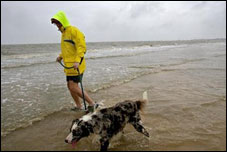
Make dog your fitness buddy


NEW YORK: When it comes to getting fit a person's best friend just might be a four-legged one.

Experts say studies show dog owners walk more, walk faster, and are more likely to enjoy an active lifestyle because of their companion animal.

"I'm fascinated by what a great motivator dogs can be," said Dr. Sandra McCune, co-editor of the book, "The Health Benefits of Dog Walking for People and Pets."

McCune, an animal behaviorist based in Leicestershire, England, said studies show if you're a dog walker, you're more likely to meet the guidelines for daily activities.

Dogs are the reason behind two-thirds, 66 percent, of the walks their owners take each week, according to a recent survey of more than 1,011 adults commissioned by pet food company Mars Petcare.

One-quarter of people with children and pets regularly visit parks and other outdoor spaces because of their dog. (Reuters)